


Two Silver Trumpets: How the Holy Spirit and the Word of God Guide You
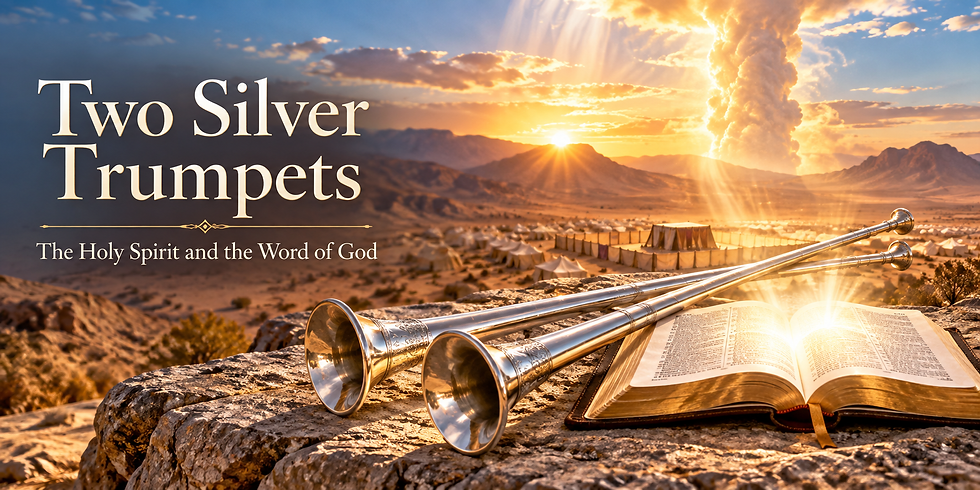
"Make thee two trumpets of silver; of a whole piece shalt thou make them: that thou mayest use them for the calling of the assembly, and for the journeying of the camps." — Numbers 10:2
When I served in the U.S. Army, two trumpet calls sounded every day. The first was Reveille, sounded in the morning and nicknamed "The Army Wakeup Call." It called the soldiers to morning assembly, marked the start of the day, and went along with the raising of the flag. The second came at the end of the day and is known as "Taps." It signalled the close of the day as the flags were lowered, and it is also played at the funerals of military personnel.
In days gone by, there were also trumpet or bugle calls for advance and retreat. A soldier had to know each call and respond to it at once, because his life and the lives of those around him could depend on it.
Long before any army had a bugle, God gave His people a similar system of sounds to direct their lives. In the wilderness He told Moses to make two silver trumpets. Those trumpets hold a lesson for every believer today about how God leads His children.
The Two Silver Trumpets of Israel
In Numbers 10:1–10, God gave Moses clear instructions. Each trumpet was to be beaten from a single, whole piece of silver. The trumpets had distinct sounds, and each sound carried a specific message:
When both trumpets sounded, the whole congregation was to gather at the door of the tabernacle (Numbers 10:3).
When one trumpet sounded, only the princes and leaders of the tribes were to assemble (Numbers 10:4).
When the alarm sounded, the camp moved forward. At the first alarm, the tribes camped on the east side packed up and set out. At the second, the tribes on the south followed (Numbers 10:5–6). Israel never moved in confusion. Each tribe waited for its signal.
In time of war, the trumpets sounded an alarm, with a remarkable promise attached: "ye shall be remembered before the LORD your God, and ye shall be saved from your enemies" (Numbers 10:9).
In days of gladness, at the solemn feasts, at the start of each month and over the offerings, the trumpets sounded as "a memorial before your God" (Numbers 10:10).
Not just anyone could blow these trumpets. God assigned that duty to the priests, the sons of Aaron, as "an ordinance for ever throughout your generations" (Numbers 10:8).
What the Two Silver Trumpets Teach Us Today
The silver trumpets belonged to Israel's journey through the wilderness to the Promised Land, and we don't blow them in our worship today. But Paul tells us that the things which happened to Israel "happened unto them for ensamples: and they are written for our admonition" (1 Corinthians 10:11).
Israel was a pilgrim people moving toward a promised inheritance, and so are we. They needed a clear signal to know when to gather, when to move, when to stand and when to fight. We need that too. God has not left His people without direction. Just as He gave Israel two silver trumpets, He has given us two trumpets to guide us: the Holy Spirit and the Word of God.
Notice that each trumpet was made "of a whole piece." There were no joints or patches. In the same way, the Holy Spirit and the Word of God are not two separate voices competing for your attention. They come from one source and always agree. The Holy Spirit inspired the Scriptures, for "holy men of God spake as they were moved by the Holy Ghost" (2 Peter 1:21). The Word is called "the sword of the Spirit" (Ephesians 6:17). God spoke of both together when He said, "My spirit that is upon thee, and my words which I have put in thy mouth, shall not depart out of thy mouth" (Isaiah 59:21).
Also notice who blew the trumpets: the priests. Under the New Covenant, every believer has been made "a royal priesthood" (1 Peter 2:9) and "kings and priests unto God" (Revelation 1:6). The trumpets are no longer heard only by a select few. Every child of God has the right to hear them and the responsibility to respond.
The First Trumpet: The Guidance of the Holy Spirit
Before Jesus went to the cross, He made His disciples a precious promise: "I will not leave you comfortless: I will come to you" (John 14:18). He told them the Father would send "another Comforter, that he may abide with you for ever" (John 14:16). That Comforter is the Holy Spirit, and Jesus described His work in detail:
He teaches. "He shall teach you all things, and bring all things to your remembrance, whatsoever I have said unto you" (John 14:26).
He guides. "When he, the Spirit of truth, is come, he will guide you into all truth" (John 16:13).
He shows what lies ahead. "He will shew you things to come" (John 16:13).
He leads God's children. "For as many as are led by the Spirit of God, they are the sons of God" (Romans 8:14).
People often say, "Let your conscience be your guide." Conscience is a gift from God, but it can be weakened, dulled or even "seared with a hot iron" (1 Timothy 4:2). The Holy Spirit is far more than a moral instinct. He is God Himself living within the believer. Paul spoke of his "conscience also bearing me witness in the Holy Ghost" (Romans 9:1). The Holy Spirit sharpens the conscience and speaks through it.
The Alarm of Warning
Like Israel's trumpet, the Holy Spirit sounds an alarm when danger is near. You may be about to make a decision, enter a relationship, sign an agreement, or say words you'll regret, and you sense an inner check, a quiet unease, a "no" in your spirit. Isaiah described it this way: "Thine ears shall hear a word behind thee, saying, This is the way, walk ye in it, when ye turn to the right hand, and when ye turn to the left" (Isaiah 30:21).
I have experienced this more times than I can count. The Holy Spirit has stopped me from doing things I shouldn't do, and He has pulled on the reins when I was about to say something I shouldn't say. If you are a child of God, I'm sure you have felt it too.
I have also learned, sometimes painfully, what happens when I ignore that alarm. Every time I pushed past His warning, I paid a price, and often it cost far more than obedience would have. Scripture has an example of this. When Paul warned the crew of the ship taking him to Rome that the voyage would bring "hurt and much damage," the centurion trusted the master of the ship instead (Acts 27:10–11). The storm came, and the ship was lost. Their lives were spared only because God was merciful.
That is why Scripture warns us, "Grieve not the holy Spirit of God" (Ephesians 4:30), and "Quench not the Spirit" (1 Thessalonians 5:19). When we keep ignoring His voice, it becomes harder to hear.
The Call to Advance, or to Stand Still
The Holy Spirit doesn't only warn. He also sounds the call to advance. He stirs you to go deeper in prayer, to step out in faith, to forgive, to give, to serve or to share the Gospel. He also knows when you should not move. In Acts 16:6–7, Paul and his companions were "forbidden of the Holy Ghost" to preach in Asia, and when they tried to go into Bithynia, "the Spirit suffered them not." That closed door led them to Macedonia and a great harvest in Europe.
Some people imagine a little angel on one shoulder and a little devil on the other, each whispering advice. We don't literally have tiny beings perched on our shoulders, but the battle between right and wrong in our hearts is real. The difference is that the believer doesn't have to guess which voice to follow. "The Spirit itself beareth witness with our spirit, that we are the children of God" (Romans 8:16). When we learn to recognise and obey His voice, we won't go wrong.
The Second Trumpet: The Word of God
The second trumpet is the Holy Bible. For many Christians, this trumpet sits silent on a shelf, in a drawer or on the coffee table, gathering dust. Today it might be an app on your phone, but the principle is the same. A Bible app you never open is just as silent as a leather-bound Bible you never read.
God's Word is not an ordinary book. "All scripture is given by inspiration of God, and is profitable for doctrine, for reproof, for correction, for instruction in righteousness: that the man of God may be perfect, throughly furnished unto all good works" (2 Timothy 3:16–17). It is "quick, and powerful, and sharper than any twoedged sword... and is a discerner of the thoughts and intents of the heart" (Hebrews 4:12). It is "a lamp unto my feet, and a light unto my path" (Psalm 119:105).
Solomon described how the Word guides the one who keeps it: "When thou goest, it shall lead thee; when thou sleepest, it shall keep thee; and when thou awakest, it shall talk with thee" (Proverbs 6:22).
Has God Already Answered?
Sometimes we pray and wait, and it seems God is silent. But could it be that He has already answered, and the answer is written in His Word? Many of the questions we bring to God, about forgiveness, marriage, money, honesty, anxiety, anger or purity, are answered clearly in Scripture. We haven't taken the time to look.
Sometimes, if we're honest, we want God to speak audibly so we don't have to put in the effort of seeking. But God rewards those who "diligently seek him" (Hebrews 11:6). The Bereans were commended because they "searched the scriptures daily" (Acts 17:11). God warns, "My people are destroyed for lack of knowledge" (Hosea 4:6), and often not because the knowledge was unavailable, but because it was never sought.
There is nothing wrong with godly counselling. Scripture says, "in the multitude of counsellors there is safety" (Proverbs 11:14). But the psalmist had a Counsellor available at all times: "Thy testimonies also are my delight and my counsellors" (Psalm 119:24). Before you run to everyone else, open the Book. You may find the answer is already waiting for you.
How to Hear the Trumpets
A trumpet only helps those who are listening for it. Here's how to keep your ears open to both:
Be still. "Be still, and know that I am God" (Psalm 46:10). Many of us are so busy talking, scrolling and worrying that we can't hear God speak. Frankly, sometimes we need to be quiet and listen.
Listen more than you speak. "Let every man be swift to hear, slow to speak" (James 1:19). Pray like young Samuel: "Speak; for thy servant heareth" (1 Samuel 3:10).
Open the Word daily. Give the Word a set time each day. The Holy Spirit often speaks by bringing Scripture you have read to your remembrance (John 14:26), but He can't remind you of what you have never read.
Test every leading by the Word. The Spirit and the Word are made "of a whole piece." Any inner voice that contradicts Scripture is not the Holy Spirit. "Believe not every spirit, but try the spirits whether they are of God" (1 John 4:1).
Obey quickly. Israel moved when the trumpet sounded, not days later. Delayed obedience is often disobedience. "Be ye doers of the word, and not hearers only" (James 1:22).
Keep your heart tender. Repent quickly when you've ignored His voice. "To day if ye will hear his voice, harden not your hearts" (Hebrews 3:15).
Advance or Stand Still
When Israel stood trapped between Pharaoh's army and the Red Sea, God's first word through Moses was, "Fear ye not, stand still, and see the salvation of the LORD" (Exodus 14:13). Then came the next command: "Speak unto the children of Israel, that they go forward" (Exodus 14:15). There is a time to stand and a time to advance, and only God's voice can tell you which is which.
Many believers have never discovered the benefit of these two trumpets. But if you will listen for their signal, you may receive the very answer you need, whether it is to move forward in faith or to stand still and watch God work.
A Trumpet Still to Come, The Last Trumpet
God loves us so much that He gave us these two trumpets to guide us while Christ prepares a place for us. Jesus said, "I go to prepare a place for you. And if I go and prepare a place for you, I will come again, and receive you unto myself" (John 14:2–3).
One day, another trumpet will sound, and it will be the last. "For the Lord himself shall descend from heaven with a shout, with the voice of the archangel, and with the trump of God: and the dead in Christ shall rise first" (1 Thessalonians 4:16). "In a moment, in the twinkling of an eye, at the last trump... the dead shall be raised incorruptible, and we shall be changed" (1 Corinthians 15:52).
Those who have learned to hear and obey the Holy Spirit and the Word today will be ready to answer that final trumpet with joy. Listen, obey and trust, and you may catch the gleam of silver as those trumpets sound out God's direction for your life.
A Call to Surrender
The guidance of the Holy Spirit is the inheritance of God's children. When you believe in Jesus Christ, you are "sealed with that holy Spirit of promise" (Ephesians 1:13), and He comes to live within you, teach you, guide you and open the Scriptures to you.
If you have never surrendered your life to Jesus, you don't have to walk through this wilderness alone or be unready when the last trumpet sounds. "Behold, now is the accepted time; behold, now is the day of salvation" (2 Corinthians 6:2).
If you want to surrender to Jesus today and become a true child of God, pray the Salvation Prayer here.
If you prayed that prayer for the first time, we would love to hear from you. Email us at newlife@lovefaithandmiracles.com
About the Author
Jerry D. Ousley is the author of Soul Challenge, Soul Journey, Ordeal, The Spirit Bread Daily Devotional and his first novel, The Shoe Tree. His newer books include Finality and Dividing God's Church. Visit spiritbread.com to download these and more, completely free of charge.


Comments